The Interstellar Wormhole Explained: Why It Looks Like a Crystal Ball
Most films draw wormholes as swirling tunnels. In Interstellar, the wormhole near Saturn is a shimmering sphere, like a crystal ball with a distorted view of another galaxy inside it. That look was not an artistic guess: it came from tracing light rays through a wormhole spacetime designed for the film. This page explains that wormhole, and our own ray-traced recreations of it.
Why a wormhole looks like a sphere
A wormhole connects two distant regions of space through a short-cut. Its mouth is a sphere in 3D space, just as a hole in a 2D sheet is a circle. Looking at the mouth from outside, you see light that has come through the wormhole from the other end, so the sphere shows a warped picture of the sky on the far side.
Around the sphere, the wormhole's gravity bends light like a black hole does, so the background stars near its edge are stretched into an Einstein ring. Unlike a black hole, there is no dark shadow: light is not trapped, it passes through.
The three-parameter wormhole
The Double Negative visual effects team and Kip Thorne described the film's wormhole in the paper Visualizing Interstellar's Wormhole (James, von Tunzelmann, Franklin and Thorne, American Journal of Physics, 2015). It builds on the simpler Ellis wormhole (1973), which has only one adjustable parameter, its throat radius. The film's version has three:
- Throat radius ρ: the size of the wormhole's narrowest point.
- Length 2a: the length of the cylindrical interior, the tunnel itself.
- Lensing width W: how gradually space curves from the throat out into flat space. It controls how strongly the wormhole bends light around it.
Our Chapter 5 derives the metric for this wormhole, the equations light follows through it, and a backwards ray-tracing algorithm that turns them into images. A gentler introduction to the shapes is in wormhole embedding diagrams explained.
What the length does
In Chapter 6 we rendered the wormhole with a Saturn image on one side and the Milky Way on the other, changing one parameter at a time. With a very short wormhole, you see a single, large, distorted image of the far side inside the sphere. Make the tunnel longer and that image shrinks towards the centre, and a second, more distorted image appears on the opposite side. Make it longer still and light can wind around the tunnel several times on the way through, so multiple images appear on alternating sides, each smaller and more stretched than the last.
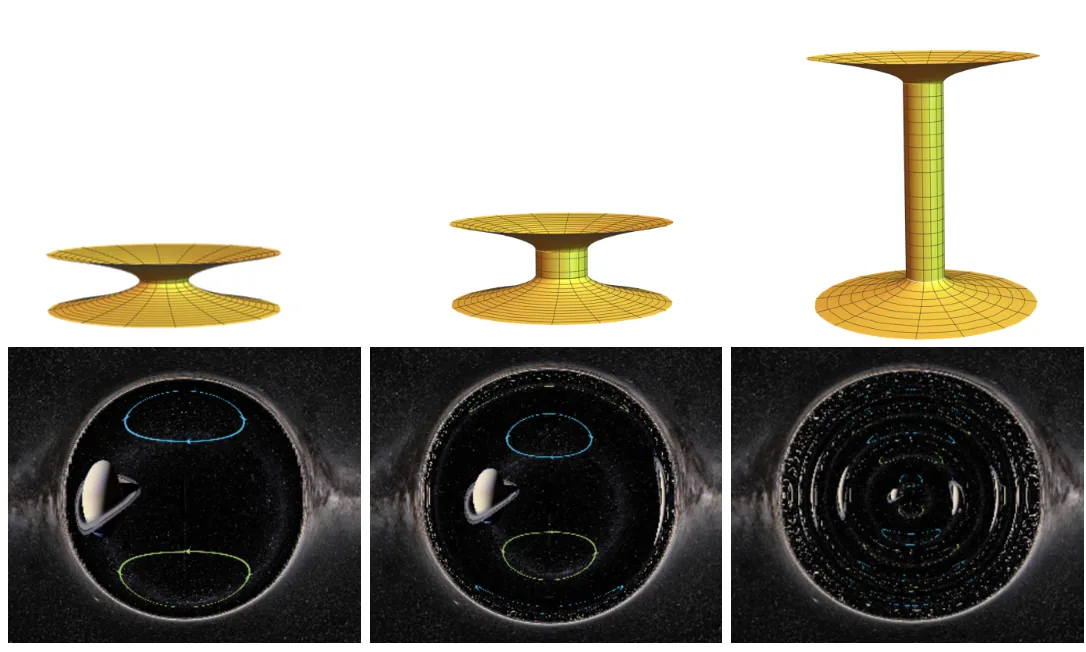
What the lensing width does
A wormhole with a small lensing width has sharp edges and bends little light around itself. Increase the lensing width and the curvature outside the mouth spreads out, so more gravitational lensing happens: a secondary image of the Milky Way appears around the sphere, and a secondary image of Saturn appears inside it.
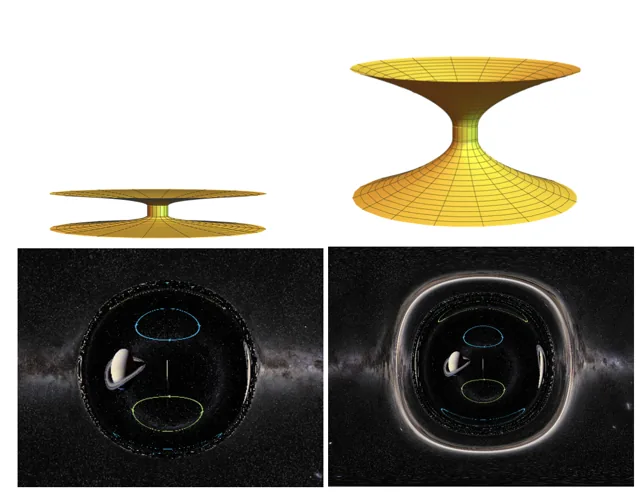
What it would take to keep it open
General relativity allows wormhole shapes like this mathematically, but an ordinary wormhole would pinch off faster than anything could cross it. Holding one open needs material with negative energy density, often called "exotic matter", which violates the energy conditions that normal matter obeys. Quantum physics allows small, temporary negative energies, but nobody knows whether enough could ever be gathered to hold a wormhole open. In the film, the wormhole was placed there by an advanced civilisation, which neatly avoids the question.
No wormhole has ever been observed. For how the different theoretical models compare, see Ellis vs Morris–Thorne wormholes, and for the time travel questions they raise, wormholes and time travel.
Build your own
The wormhole embedding diagram generator uses the same three parameters as the film's wormhole. Set the throat radius, length and lensing width and see the shape change, then download and share the result. More renders are in the gallery.
FAQ
- Is the Interstellar wormhole scientifically accurate? Its appearance is: it was rendered by tracing light through a real wormhole solution of Einstein's equations. Whether such a wormhole can exist is another matter, as it would need exotic matter to stay open.
- Why doesn't it look like a tunnel? Because the mouth of a wormhole in 3D space is a sphere. You look into it from any side, not into a funnel.
- Is a wormhole the same as a black hole? No. Light that enters a black hole's horizon cannot get out; light entering a traversable wormhole comes out the other end.
- What is an Einstein–Rosen bridge? The original wormhole found in 1935, which pinches off too fast for anything to cross. See Einstein–Rosen bridge explained.
Try a simulation or calculator
- Black hole image simulation — upload an image and see gravitational lensing
- Black hole embedding diagram — visualize curvature as an embedded surface
- Wormhole embedding diagram — explore throat geometry parameters
- Black hole calculators: Schwarzschild radius and time dilation (including Miller’s planet)
- Gallery: ray-traced black holes and wormholes
- Browse all articles