Spacetime Simulations
Interactive tools and science-accurate articles about black holes, wormholes, and curved spacetime. Run a simulation, then read the concepts behind what you see—written for curiosity, not hype.
Featured articles
Miller’s Planet Time Dilation: Could 1 Hour Really Equal 7 Years?
The physics behind Interstellar’s Miller’s planet: why a non-spinning black hole can’t do it, how Gargantua’s near-maximal spin makes 1 hour = 7 years possible, and the numbers you can check yourself.
Gargantua Explained: The Science of Interstellar’s Black Hole
How big Gargantua is, why it spins so fast, why the film’s images use a slower spin, and what the glowing halo over the top really is, compared with real Event Horizon Telescope images.
Schwarzschild Radius Explained (What It Means, What It Doesn’t, and Common Misconceptions)
A beginner-friendly explanation of the Schwarzschild radius and why it’s not a physical surface—plus links to lensing/ray-tracing notes.
Black Hole Shadow Explained (What Was Actually Imaged and Why It Looks Like a Ring)
What the black hole “shadow” means in relativity and imaging, why rings appear, and how lensing and photon paths shape the picture.
Event Horizon vs Photon Sphere vs Singularity (Clear Definitions + Visual Intuition)
A clear glossary-style guide to three commonly confused concepts in black hole physics, with links to the simulations and chapter notes.
Hawking Radiation Explained (What It Is, What We’ve Observed, and What’s Still Theoretical)
A grounded explanation of Hawking radiation: the idea, what it would imply, and why it’s difficult to observe directly.
Spacetime Curvature for Beginners (From Minkowski Space to Gravity as Geometry)
A structured beginner guide to spacetime curvature and geodesics, connecting tensor calculus and metrics to what black holes actually do to light.
Black Hole Gravitational Lensing Explained (Einstein Rings, Photon Sphere, and the Shadow)
A clear, science-accurate guide to how black holes bend light, what the photon sphere is, and why Einstein rings appear—plus links to interactive simulations.
Generate realistic black hole images by adjusting mass and angular momentum. See how black holes warp light around them.
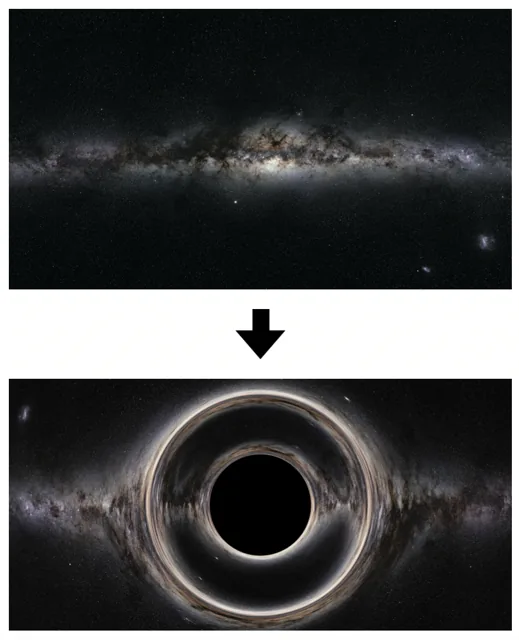
Image of Milky Way used before black hole distortion: Credit: ESO/S. Brunier. https://www.eso.org/public/images/eso0932a/
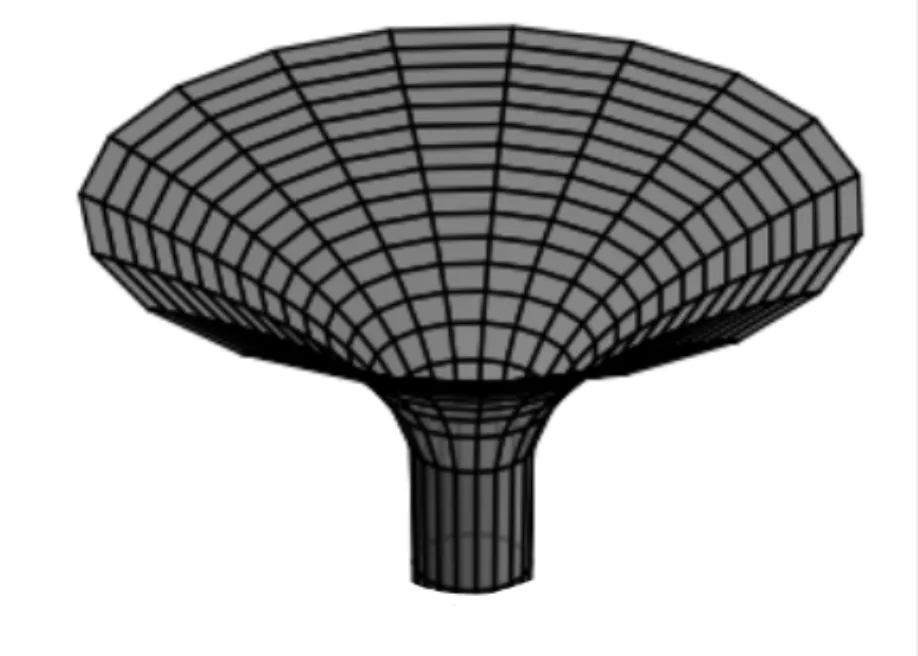
Visualize black hole geometry with an embedded spacetime diagram—useful intuition for curvature and horizons.
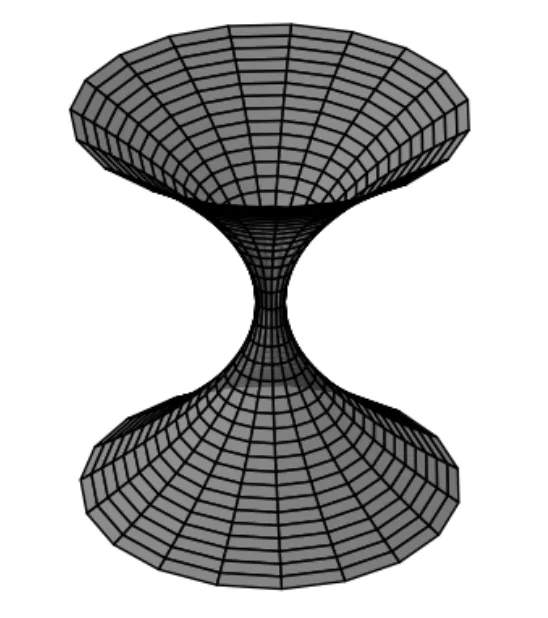
Build a wormhole embedding by setting throat radius, length, and related parameters. Explore cosmic “shortcut” geometry carefully.
How big would Earth be as a black hole? Could an hour on Miller's planet really be seven years? Work it out with the Schwarzschild radius calculator and the time dilation calculator.
Ray-traced black holes and Interstellar-style wormholes, each linked to the chapter that shows how it was made.
Chapter-style notes on metrics, geodesics, and black hole physics that support the simulations and articles.
Answers about black holes, wormholes, Interstellar-style questions, and how the tools on this site work.